
Arrow Spine Chart
An arrow must bend the right amount as it leaves the bow — too stiff or too weak and it flies off line and groups poorly. Spine charts from arrow makers are the place to start, but they all rest on the same few ideas: draw weight, arrow length and point weight. This guide explains those ideas with approximate starting points, and describes a pack of printable arrow build and tuning sheets.
- Instant download
- Editable Word & Excel
- Print-ready PDF
- 7-day refund
5 files · PDF, DOCX, XLSX
Arrow Spine and Build Pack
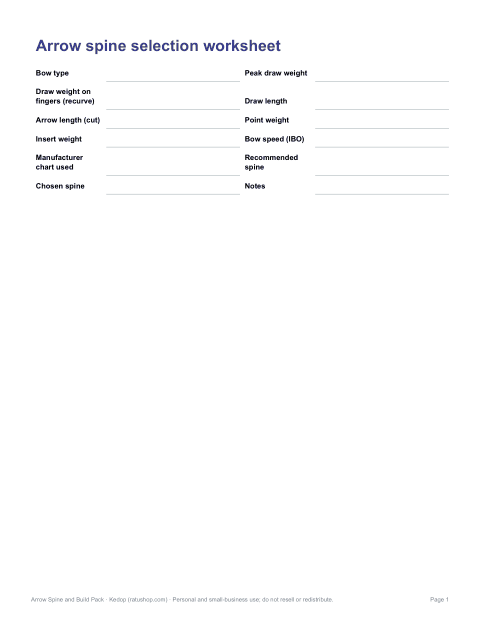
Arrow spine selection worksheet, Excel arrow build calculator (weight, FOC, kinetic energy, momentum), printable build sheet, tuning log and a blank spine chart template.
- Spine worksheet (PDF/DOCX)
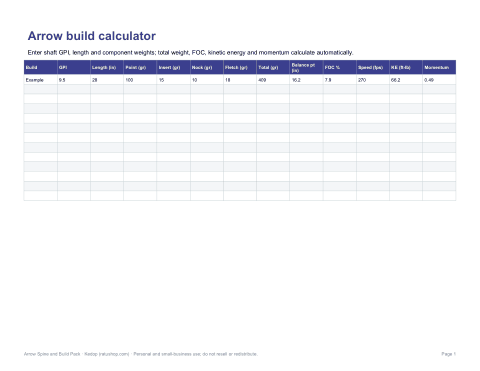
- Build calculator (XLSX)
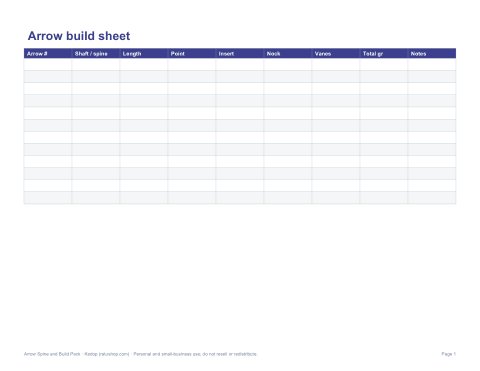
- Build sheet (PDF/DOCX)
- + 2 more
$5.00 USD, one-time 5 files · about $1.00 each
- Instant download
- 7-day refund
- Secure checkout by Stripe
7-day money-back guarantee. Full refund within 7 days of purchase, even after you download.
Free sample: Spine Selection Worksheet (PDF, 59 KB)
Arrow Spine and Build Pack
Arrow spine selection worksheet, Excel arrow build calculator (weight, FOC, kinetic energy, momentum), printable build sheet, tuning log and a blank spine chart template.
- Spine worksheet (PDF/DOCX)
- Build calculator (XLSX)
- Build sheet (PDF/DOCX)
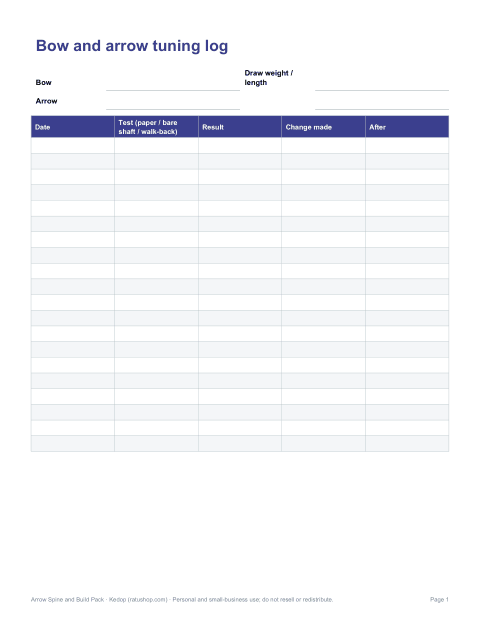
- Tuning log (PDF/DOCX/XLSX)
- Blank chart template (PDF)
Formats: PDF, DOCX, XLSX. Instant download after payment (link valid 72 hours, up to 5 downloads). AI-assisted: the templates were drafted with AI help and reviewed and laid out before publishing.
$5.00 USD, one-time 5 files · about $1.00 each
- Instant download
- 7-day refund
- Secure checkout by Stripe
7-day money-back guarantee. Full refund within 7 days of purchase, even after you download.
Free sample: Spine Selection Worksheet (PDF, 59 KB)
Full refund within 7 days — see the refund policy and license.
Free printables
Single sheets you can print right now, no sign-up. The full pack adds every sheet in one download plus the editable files.
 Printable Arrow Spine Worksheet
 Printable Arrow Build Calculator
 Printable Arrow Build Sheet
 Printable Bow Tuning Log Sheet
 Printable Arrow Spine Chart
What spine means
Static spine is a measure of how much a shaft bends under a standard load. In the common ATA (formerly AMO) method, a 1.94 lb (880 g) weight is hung from the middle of a shaft supported at points 28 inches apart; the deflection in inches, times 1,000, is the spine number. A 400-spine shaft bends 0.400 inches; a 300 is stiffer (bends less), a 500 weaker. Wooden arrows are traditionally rated in pounds of draw weight instead (for example 45–50 lb), using a different test.
Approximate starting points
| Draw weight (compound, at the peak) | Arrow length 27–28 in | Arrow length 29–30 in |
|---|---|---|
| 40–45 lb | about 500–600 | about 500 |
| 45–55 lb | about 400–500 | about 400 |
| 55–65 lb | about 350–400 | about 340–350 |
| 65–75 lb | about 300–340 | about 300 |
| 75–80 lb | about 250–300 | about 250–300 |
These are broad, general starting points with 100-grain points, not any manufacturer’s chart. Every arrow maker publishes its own chart for its shafts, and they differ — use the chart for the shaft you are buying. Recurve and longbow shooters use the draw weight at their own draw length (“on the fingers”), which is often different from the weight marked on the limbs at 28 inches.
What makes an arrow act weaker or stiffer
| Change | Effect on dynamic spine | Rule of thumb |
|---|---|---|
| Longer arrow | Weaker | Each extra inch acts roughly like a few pounds more draw weight |
| Heavier point | Weaker | Around 25 grains above 100 is often treated as about one spine step |
| Higher draw weight | Needs stiffer | Move up the chart |
| Aggressive cams / faster bow | Needs stiffer | Some charts adjust by bow speed (IBO) |
| Heavier insert or outsert | Weaker | Adds front weight |
| Release aid vs fingers | Fingers need more precise spine | Archer’s paradox with finger release |
Because length and point weight change how a shaft behaves, two archers with the same draw weight can need different spines. When in doubt between two sizes, many archers choose the stiffer one for compound bows and fine-tune with point weight.
Arrow weight, FOC and energy
| Quantity | Formula |
|---|---|
| Total arrow weight (grains) | shaft GPI × length + point + insert + nock + fletching |
| FOC (front of centre) % | (balance point − length ÷ 2) ÷ length × 100 |
| Kinetic energy (ft-lb) | arrow weight (gr) × speed² (fps) ÷ 450,240 |
| Momentum (slug-ft/s) | arrow weight (gr) × speed (fps) ÷ 225,400 |
GPI is the shaft’s grains per inch, printed on the box. Many target archers use an FOC of about 7–15%; some hunters prefer higher. Always check your local hunting regulations for minimum arrow weight or kinetic energy.
Worked example
An archer shoots a 60 lb compound bow with a 28-inch arrow and a 100-grain point. The table suggests a spine around 350–400. They choose a 350 shaft of 9.5 GPI: 28 × 9.5 = 266 grains, plus 100 point, 15 insert, 10 nock and 18 grains of vanes, gives 409 grains. The balance point is 16.2 inches from the nock throat, so FOC = (16.2 − 14) ÷ 28 × 100 ≈ 7.9%. At 270 fps, kinetic energy is 409 × 270² ÷ 450,240 ≈ 66 ft-lb.
Checking your spine by tuning
- Paper tuning: shoot through paper from a few feet away and read the tear. Tears that point left or right can indicate spine or rest issues.
- Bare-shaft tuning: compare where un-fletched and fletched arrows hit at 15–20 yards; a consistent offset suggests a spine mismatch.
- Walk-back tuning: helps with rest position and centre shot.
- Adjust point weight or draw weight a little to change dynamic spine before buying new shafts.
- Record every change in a tuning log so you can undo it.
Safety
Never dry-fire a bow, and never shoot an arrow that is too weak for the bow — an under-spined carbon arrow can break on release and injure the shooter. Flex each carbon arrow and check for cracks before shooting. Ask an archery shop to check your set-up if you are unsure.
What’s in the pack
- Arrow spine selection worksheet (draw weight, length, point weight, recommended range)
- Excel arrow build calculator: total weight, FOC, kinetic energy and momentum
- Printable arrow build sheet for recording components
- Paper and bare-shaft tuning log
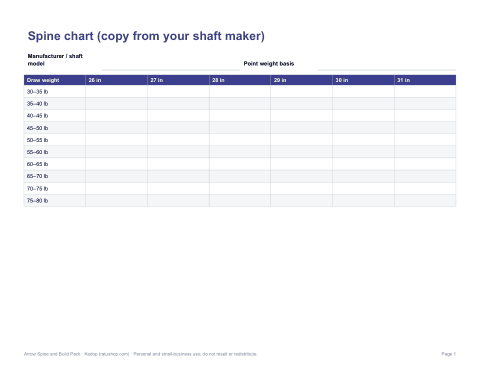
- Blank chart template to copy the manufacturer chart for your shafts
All sheets print on US Letter and A4; the calculator opens in Excel and Google Sheets.
AI-assisted content
This guide was drafted with AI assistance and reviewed before publishing. Spine figures are general starting points — always use the arrow manufacturer’s chart and a qualified pro shop for final selection.
Frequently asked questions
What does arrow spine 400 mean?
The shaft bends 0.400 inches under a 1.94 lb weight with supports 28 inches apart.
Is a lower spine number stiffer?
Yes — 300 is stiffer than 400.
What spine do I need for a 50 lb bow?
Often around 400–500 depending on arrow length and point weight; check the shaft maker’s chart.
Does point weight change spine?
Heavier points make an arrow act weaker (dynamic spine).
How do I calculate FOC?
(Balance point − half the arrow length) ÷ arrow length × 100.
Is this a subscription?
No, it is a one-time download.